7075 Aluminum Forging Parts – Huatuchang
What Is 7075 Aluminum Forging?
7075 alloy belongs to the Al-Zn-Mg-Cu system and is a high-strength, wrought aluminum alloy that can be strengthened by heat treatment, often chosen for aerospace, motorsport, and high-load structural applications.. Developed by the Aluminum Company of America and finalized in 1944, it was already used in aircraft during the later stages of World War II. This alloy can be produced in various forms and sizes, making it currently the most widely used high-strength aluminum alloy. It has several heat treatment conditions, such as T6, T73, and T76; among them, T6 offers the highest strength but relatively lower fracture toughness. Its corresponding designations are 7075 (USA), B95 (Russia), and A7075 (Japan), with the main related standards being Q/6S 841-1990 and Q/S 309-1990.
When combined with forging technology, its mechanical properties are further enhanced, producing components that can handle extreme stress, vibration, and fatigue.
Forging refines the metal’s grain flow, aligning it with the shape of the part — resulting in higher strength and reliability compared to casting or billet machining.
For industries that demand lightweight yet robust metal parts, 7075 aluminum forging offers the ideal balance between performance and efficiency.
*The above are the minimum mechanical properties of 7075 in the T6 condition.
Hot die forging process flow
Saw Cutting
Heating
Forge
Trimming
Heat Treatment
Vibratory Polishing


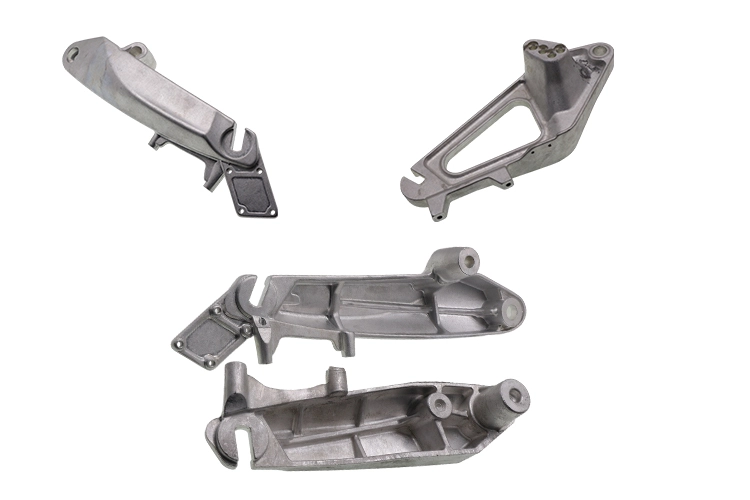
Typical 7075 Forged Parts We Produce
We manufacture custom 7075 aluminum forgings for diverse applications across multiple industries:
Suspension Arms & Control Links – High strength-to-weight ratio for dynamic load environments
Crank Arms (Motorcycle & Bicycle) – Excellent fatigue resistance and precision balance
Fork Clamps & Triple Trees – Improved stability and impact strength
Hub Housings & Flanges – Superior durability under torque and rotational stress
Brake Caliper Bodies – Exceptional rigidity for high-performance braking systems
Mounting Brackets & Joints – Dimensional accuracy for critical assembly interfaces
Industrial Connectors & Tooling Components – Reliable mechanical integrity for heavy-duty use
Every forging project can be customized based on 2D/3D drawings, target weight, and surface finish requirements.
Engineering & Quality Assurance
From early-stage design to final inspection, our engineering and quality systems are built to ensure product reliability and manufacturing efficiency.
Do you have questions for Al 7075 forging?
We’ve answered common questions about 7075 aluminum forging. Still have questions? Contact us — we’re glad to assist.
The forging temperature is 380–440°C (720–820°F).
Yes, they can. However, due to the alloy composition, anodizing 7075 is more challenging than with 6xxx series aluminum.
We can produce forgings up to 250 mm in size.