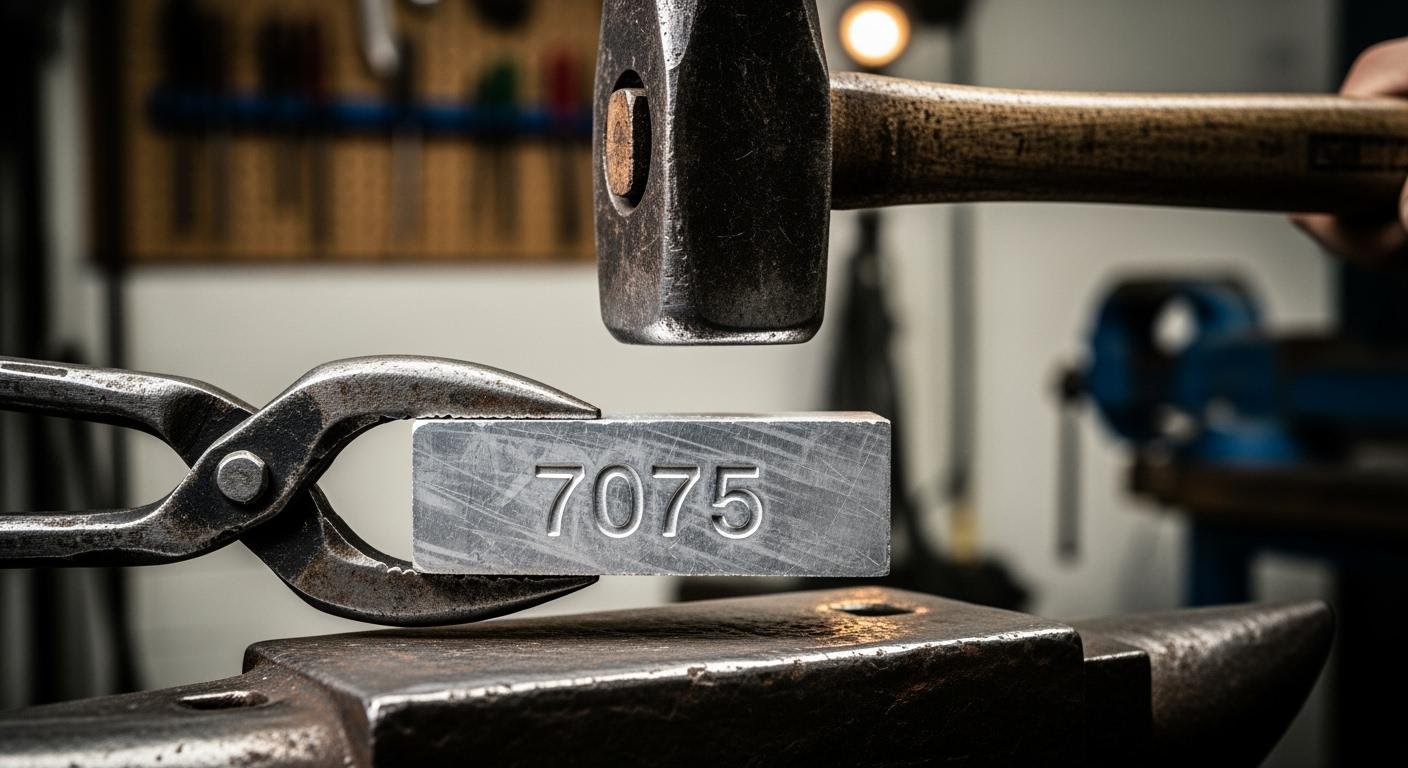
Can 7075 Aluminum Be Forged?
Yes, 7075 aluminum can be forged, but the process demands careful attention to detail. This alloy offers high strength and sees frequent use in aerospace and other high-stress environments. Forging 7075 aluminum presents several unique challenges:
Issues with lubrication
Impurities affecting quality
Temperature control and proper post-forging treatments play a key role in achieving the desired properties.
7075 Aluminum Properties
Alloy Composition and Strength
7075 aluminum stands out because of its unique chemical makeup. This alloy contains high levels of zinc, magnesium, and copper, which give it impressive mechanical properties. The table below compares the main elements in 7075 aluminum with another popular alloy, 6061:
Alloy | Zinc (%) | Magnesium (%) | Copper (%) |
|---|---|---|---|
7075 | 5.6-6.1 | 2.1-2.9 | 1.2-2.0 |
6061 | 0.9 | 1.0 | N/A |
The high zinc and magnesium content in 7075 aluminum leads to greater hardness and strength than 6061. Engineers often choose this alloy for its high strength-to-weight ratio, which means it can handle heavy loads without adding much weight.
Mechanical properties of 7075 aluminum also set it apart. The alloy shows a minimum tensile strength of 83 ksi and a minimum yield strength of 73 ksi. Elongation values range from 8% to 11%, and the reduction of area can reach up to 25%. These numbers show that 7075 aluminum can resist deformation and maintain its shape under stress.
Applications in Forging
Many industries rely on forged 7075 aluminum parts because of their durability and performance. The aerospace, military, and automotive sectors use this alloy for critical components that face constant movement and pressure changes. Aerospace components such as landing gear, engine parts, and structural elements benefit from the alloy’s fatigue resistance.
Other common uses include:
Military equipment like artillery shells and tank parts
Automotive wheels and suspension systems
Sporting goods such as baseball bats and hockey sticks
Manufacturers value 7075 aluminum for its high strength, lightweight nature, corrosion resistance, and machinability. These qualities make it a cost-effective choice for demanding applications.
Forging Process for 7075 Aluminum
Preheating and Preparation
The forging process for 7075 aluminum begins with careful preheating of both the billet and the dies. Proper preheating ensures uniform temperature distribution and reduces the risk of thermal shock. The recommended preheating temperature range for 7075 aluminum billets falls between 700° and 900°F. This step prepares the material for deformation and helps maintain its mechanical properties.
Material | Preheating Temperature Range |
|---|---|
7075 Aluminum | 700° to 900°F |
Preheating the dies also plays a crucial role. Studies show that die temperatures between 100°C and 200°C can significantly affect the microstructure of forged 7075 aluminum. Higher preheating temperatures tend to produce coarser grain sizes. This change in grain structure impacts mechanical properties such as elongation and hardness. For example, the maximum elongation observed reached 4.85%, while hardness decreased as preheating temperatures increased. These findings highlight the importance of controlling both billet and die temperatures to achieve the desired balance of strength and ductility.
Die Forging Techniques
Closed-die forging stands out as the most effective technique for shaping 7075 t6 aluminum. In this method, the heated metal is placed within a precisely machined cavity. The die then compresses the billet, forcing it to fill the cavity and take on the desired shape. This process aligns the internal grain structure with the flow of the metal, which enhances strength, toughness, and fatigue resistance.
The forging process often involves multi-pass forging, where the billet undergoes several deformation steps. Each pass further refines the grain structure and improves the mechanical properties. The pressure applied during closed-die forging increases the density of 7075 t6 aluminum, resulting in parts with superior mechanical performance compared to those produced by casting or machining. Manufacturers rely on this method to produce aerospace and automotive components that demand a high strength-to-weight ratio.
Temperature and Pressure Control
Precise temperature and pressure control are essential during the forging process for 7075 t6 aluminum. The optimal forging temperature range lies between 370°C and 450°C. Maintaining this range helps minimize defects and maximize mechanical properties.
The optimal forging temperature range for 7075 t6 aluminum is between 370-450°C.
Temperatures below this range can cause poor material flow and increase the risk of cracking.
Temperatures above this range may result in coarse grains and reduced mechanical properties.
Infrared temperature monitoring systems help keep temperature deviations within ±5°C.
Pressure also plays a vital role. High pressure ensures complete filling of the die cavity and promotes uniform grain flow. The forging process must account for the influence of flow stress, which changes as the temperature and deformation rate vary. Consistent pressure application prevents defects and ensures the final part meets strict quality standards.
7075 t6 aluminum responds to the forging process with notable changes in its microstructure and mechanical properties. Researchers have examined fracture behavior under mixed-mode loading, focusing on fracture toughness and mechanisms. Hot forging alters the microstructure, which directly affects properties such as tensile strength and elongation. Multiple studies have evaluated the forgeability, fracture parameters, and microstructure evolution of 7075 t6 aluminum, confirming its suitability for high-performance applications when processed correctly.
Aspect | Description |
|---|---|
Fracture Behavior | Investigated under mixed-mode loading conditions, focusing on fracture toughness and mechanisms. |
Microstructural Changes | Examined during hot forging, affecting mechanical properties significantly. |
Mechanical Properties | Evaluated through tensile tests and fracture tests post-forging, revealing the influence of deformation ratios. |
Studies Conducted | Multiple studies focused on forgeability, fracture parameters, and microstructure evolution of Al 7075-T6. |
The forging process for 7075 t6 aluminum requires strict control of temperature and pressure to achieve the best possible mechanical properties. When manufacturers follow these guidelines, they produce components that meet demanding industry standards.
Post-Forging Treatments for 7075 T6 Aluminum
Solution Heat Treatment
After forging, 7075 t6 aluminum requires a solution heat treatment to unlock its full mechanical potential. This process involves heating the alloy to a specific temperature and holding it for a set period. The goal is to dissolve alloying elements into a solid solution, which prepares the material for further strengthening. The standard parameters for solution annealing are shown below:
Process | Temperature | Duration |
|---|---|---|
Solution Annealing | 900°F | 2 hours |
During this stage, the alloy’s microstructure becomes uniform. This uniformity helps 7075 t6 aluminum achieve its high strength-to-weight ratio, which is essential for aerospace and automotive applications.
Aging and Quenching
Quenching follows the solution heat treatment. The rapid cooling locks the dissolved elements in place, creating a meta-stable structure. The next step is aging, which can be natural or artificial. Artificial aging, known as the T6 process, involves heating the alloy at a lower temperature for a longer time. The table below compares aging conditions and their effects:
Condition | Tensile Strength (MPa) | Elongation (%) |
|---|---|---|
MRF70 %+T6 | 563 | 17.73 |
as-annealed+T6 | 520 | 9.82 |
Quenching and cooling rates play a critical role in achieving the desired properties in 7075 t6 aluminum.
The choice between T4 natural aging and T6 artificial aging affects the distribution of strengthening particles.
The T6 process forms precipitates like Al2CuMg and MgZn2, which increase hardness and durability.
Aging at higher temperatures can produce larger precipitates, which may reduce hardness. Careful control of time and temperature ensures 7075 t6 aluminum reaches optimal strength and ductility.
Oberfläche Finishing
Surface finishing protects forged 7075 t6 aluminum from corrosion and improves its appearance. Two common techniques include anodizing and powder coating:
Technique | Description | Benefits |
|---|---|---|
Anodizing | An electrolytic process that thickens the oxide layer on the surface. | Increases corrosion resistance, surface hardness, and allows for color customization. |
Powder Coating | Application of charged powder, then heat curing to form a solid layer. | Provides strong corrosion defense, wear resistance, and a variety of color options. |
Tip: Surface finishing not only extends the life of 7075 t6 aluminum parts but also enhances their visual appeal for consumer products.
Manufacturers select the best finishing method based on the intended use of the component. Proper post-forging treatments ensure that 7075 t6 aluminum delivers reliable performance in demanding environments.
Key Considerations in Aluminum Forging Process
Crack Prevention and Defect Control
Crack formation presents a major challenge in the aluminum forging process, especially when working with 7075 aluminum. Engineers often observe solidification cracking and liquation cracking. Liquation cracking tends to occur in the heat-affected zone during welding. The risk increases if the weld solidifies faster than the workpiece during cooling. Large aluminum forgings frequently develop cracks due to applied stresses, strains, or thermal stresses during cooling. Several factors contribute to cracking, including alloy selection, forging process parameters, and heat treatment.
Tip: Careful control of temperature and pressure during the forging process helps reduce the risk of cracks and defects.
Common defects in the aluminum forging process include:
Solidification cracking
Liquation cracking
Cracks from applied stresses
Cracks from thermal stresses
Mechanical Properties Optimization
Metallurgical studies show that optimizing the mechanical properties of forged 7075 aluminum requires advanced treatments. Nano-treating with TiC nanoparticles refines grain size, improving structural stability. The T6 heat treatment after nano-treating maintains fine grains and enhances thermal stability. Friction stir technology combined with nano-dispersion and T6 heat treatment increases impact toughness. Adjusting friction stir welding parameters, such as rotation speed and movement speed, produces fine grains in the nugget area.
Treatment | Results |
|---|---|
Nano-treating with TiC nanoparticles | Grain refinement to less than 20 μm, improved structural stability |
T6 heat treatment post-nano-treating | Maintained grain size of 18.5 μm, excellent thermal stability |
Friction stir technology + nano-dispersion + T6 | Improved impact toughness after aging at 120 °C for 48 hours |
Friction stir welding parameters | Fine grains in nugget area with 500 rpm, 40 mm/min, 3° inclination |
Selecting the right combination of treatments during the aluminum forging process leads to superior strength and toughness.
When to Choose Forging
Manufacturers choose the forging process for 7075 aluminum when components require high strength, durability, and fatigue resistance. Forged parts offer improved microstructure and fewer defects compared to other methods. The aluminum forging process is ideal for aerospace, defense, and safety-critical applications.
Property | Forging Advantages | Other Methods |
|---|---|---|
Strength | High tensile and yield strength | Lower strength due to porosity |
Durability | Enhanced durability and toughness | Less durable, prone to defects |
Microstructure | Improved microstructure | Often contains voids and porosity |
Fatigue Resistance | Superior fatigue resistance | Inferior fatigue performance |
Common uses for the aluminum forging process include:
Defense applications
Connecting rods
Precision gears
Safety-critical parts
The forging process delivers reliable performance for demanding environments.
7075 aluminum can be forged when manufacturers control process parameters and apply proper post-forging treatments. Temperature, pressure, and heat treatment shape the alloy’s mechanical properties. Technical resources and industry standards guide professionals in high-performance uses. The table below lists recommended standards and certifications for forged 7075 aluminum:
Tempers | Standards | Certifications |
|---|---|---|
7075-T6 | ASTM B247 | AS9100 |
7075-T652 | AMS 4126 | ISO 9001 |
7075-T73 | AMS 4131 | ISO 14001 |
7075-T7352 | AMS 4141 | NADCAP HT |
7075-T74 | AMS 4147 | NADCAP NDT |
7075-T7452 | AMS-A-22771 | IATF 16949 |
Professionals should consult these resources to ensure quality and reliability in critical applications.
FAQ
What makes 7075 aluminum different from other aluminum alloys?
7075 aluminum contains more zinc and magnesium than most alloys. This composition gives it higher strength and better fatigue resistance. Many engineers choose it for demanding applications.
Can you machine forged 7075 aluminum easily?
Yes, forged 7075 aluminum machines well. It produces smooth surfaces and holds tight tolerances. Proper tool selection and cooling improve results.
Why do manufacturers use heat treatment after forging 7075 aluminum?
Heat treatment increases strength and hardness. It also improves the alloy’s durability. The process helps 7075 aluminum reach its full mechanical potential.
Which industries use forged 7075 aluminum the most?
Industry | Common Uses |
|---|---|
Luft-und Raumfahrt | Landing gear, wing parts |
Automotive | Wheels, suspension parts |
Defense | Armor, weapon components |
These industries value the alloy’s strength and reliability.
 Facebook
 LinkedIn
 X
X
 WhatsApp
 E-Mail